GEO (Generative Engine Optimization): what is it?
We increasingly hear people saying that “SEO is dead, long live GEO” – especially among those who enjoy proclaiming the dawn of a revolution. Should we panic and throw away years of best practices in search engine optimization? Certainly not. In reality, traditional SEO (Search Engine Optimization) isn’t “dead”: it’s evolving. A new discipline is emerging, complementary to SEO, designed for AI-powered search engines like ChatGPT or Perplexity. Its name: GEO, short for Generative Engine Optimization.
In this article, we will demystify the concept of GEO. You’ll learn what Generative Engine Optimization is, how it differs from traditional SEO, and why it is becoming essential with the rise of generative AI. The goal is to give you clear explanations (even if you’re not a technical expert), along with concrete examples.
Get ready: generative AI is changing the game of online search. With a little curiosity and the right practices, you can embrace this innovation confidently and turn it into a competitive advantage.
What does “GEO” mean ?
Generative Engine Optimization (GEO) refers to all content optimization techniques aimed at getting your brand or web pages to appear in the answers generated by AIs (also called conversational engines) such as ChatGPT (search mode), Google SGE (Search Generative Experience), Perplexity.ai, Bing Chat, Claude, or You.com. In other words, where traditional SEO seeks to rank you at the top of search results, GEO aims to integrate you directly into the response that an AI formulates for the user.
Put simply, the goal of GEO is no longer just to appear at the top of a list of links, but to be included, referenced, and cited within the answer an AI provides to the user. It’s no longer about earning a ranking position, but about earning a citation from the generative engine.
This shift in objective changes the very nature of optimization: you’re no longer creating content solely for a “static” search engine (which merely indexes and ranks pages), but for an AI model that understands, reinterprets, synthesizes, and redistributes information.
GEO vs SEO: what are the differences?
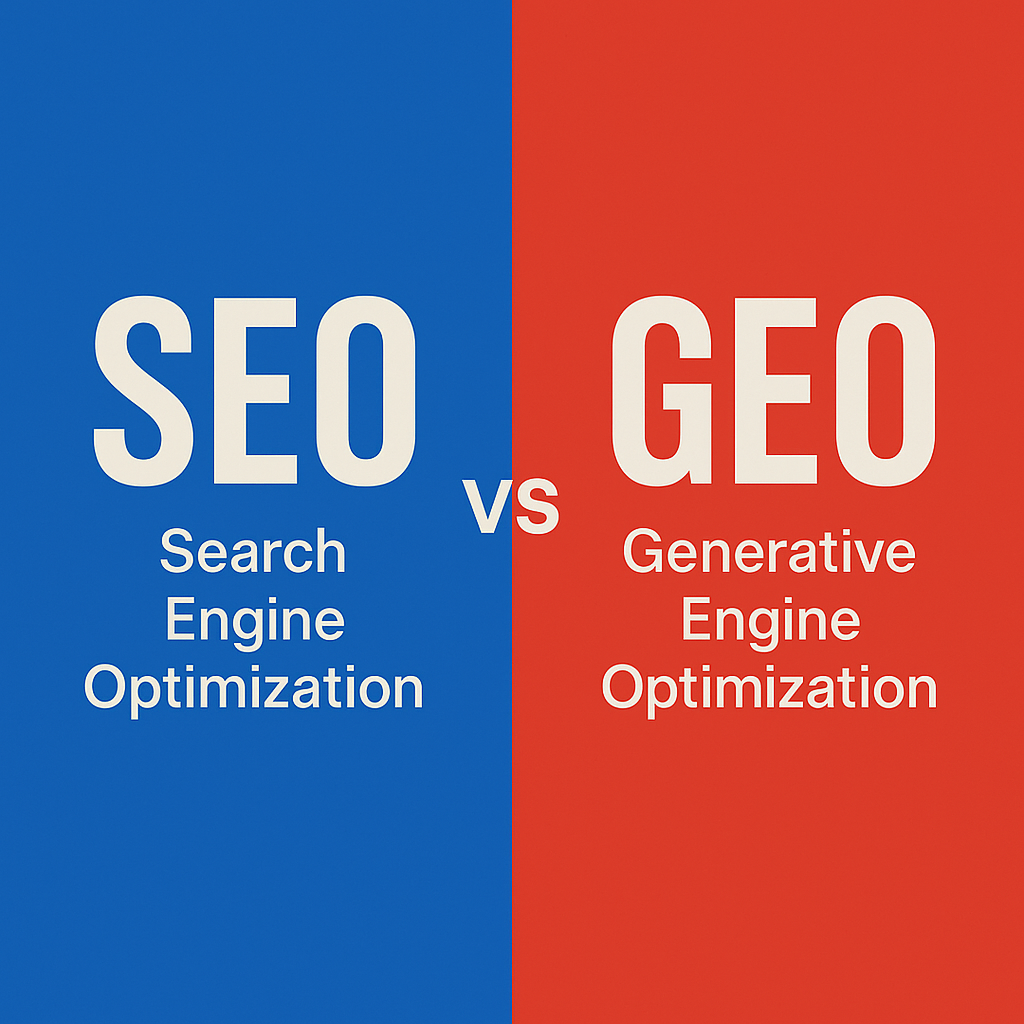
GEO and SEO share the same fundamental goal: making your content visible and relevant in order to answer user queries, regardless of the underlying technology. In fact, AI-driven engines ultimately pursue the same purpose as Google or Bing: providing a satisfying answer to the user’s question. To do so, they must index content, evaluate its quality and relevance, and present a meaningful result.
On these points, the foundations of SEO (quality content, relevance, user experience, and the E-E-A-T principles – Experience, Expertise, Authoritativeness, Trustworthiness) remain fully applicable to GEO. In other words, GEO and SEO “follow the same logic” of optimization, applied to new types of responses.
On the other hand, several key differences set GEO apart from traditional SEO:
- Final objective: in SEO, the goal is to improve your site’s ranking on the search engine results page (SERP) of a traditional search engine. In GEO, the objective is to be cited and integrated into the AI-generated response. Your content therefore needs to be sufficiently informative and trustworthy for the AI to select it and include it in its synthesis.
- Relevance criteria: traditional SEO is heavily focused on keywords (the right words in your pages to match typed queries) and on popularity signals such as backlinks. GEO, however, relies more on the semantic and contextual understanding of AIs. Since conversational queries are longer and more nuanced than a string of keywords, GEO-optimized content aims to cover a topic in depth and with context, rather than simply repeating an exact keyword. (Queries addressed to AIs already average 23 words, compared to 4 words for traditional searches — a sign that they are much more detailed and natural.)
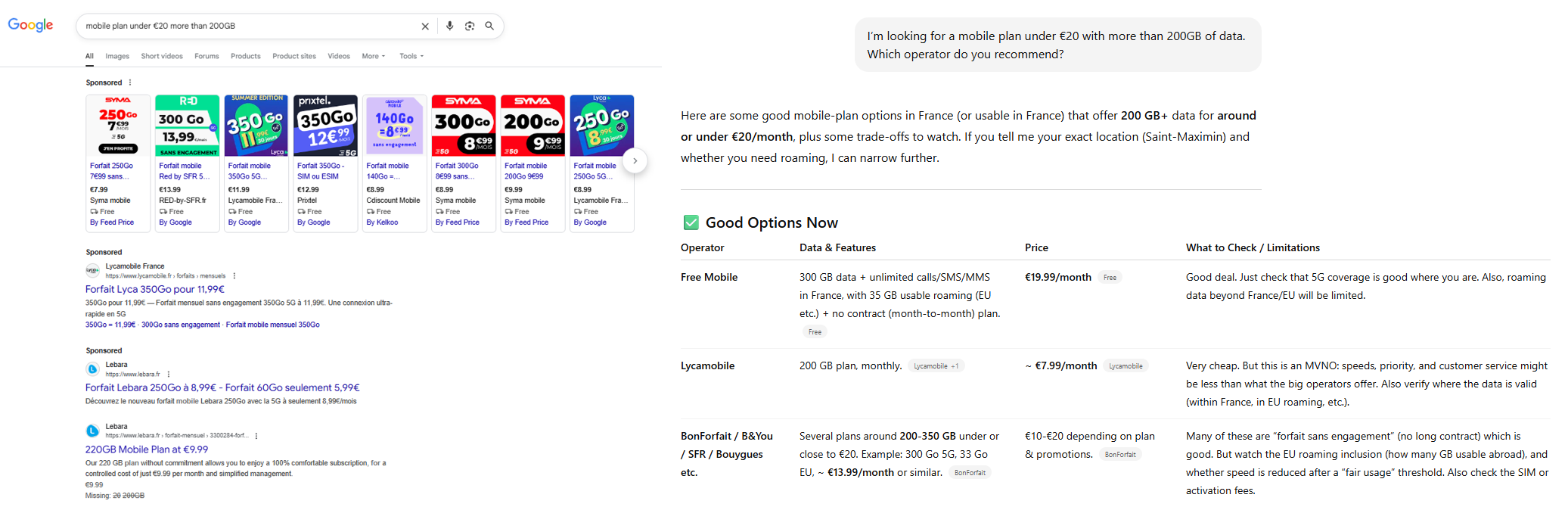
- Result format: a search engine like Google lists 10 blue links (plus snippets, images, etc.), while a generative engine provides a single written answer, often citing its sources through references embedded in the text. Ranking matters less than the relevance of the content itself: if your page is the best source, the AI may cite it as the first reference in its explanatory text, or even draw from it without always displaying a direct link. There is no visible #1 position in the same way — you are either included in the answer, or you remain invisible.
- Authority and trust: in traditional SEO, a site’s popularity (domain authority, number and quality of backlinks) is a major ranking factor. In GEO, AIs will favor content that demonstrates authority through reliability and sources. For example, generative models give weight to pages that cite studies, data, or trusted sources (government sites, universities, recognized publications). Content that backs up its claims with verifiable facts will be considered more trustworthy by the AI. In this sense, including source citations or statistics in your content can significantly increase your chances of being picked up in a generative answer — up to +40% visibility according to a recent study.
- Content optimization: SEO has trained you to polish your titles, meta descriptions, keyword density, etc. In GEO, the priority is to ensure that content is clear, educational, and well-structured. AIs love texts that are easy to break down: short paragraphs, bullet lists, FAQs, comparison tables… This type of structure allows the model to better understand and extract information without distorting it. Tests have shown that generative engines are more likely to reuse content structured as bullet points or step-by-step guides. In short, well-structured and segmented content has a higher chance of being “pulled in” and reused than unstructured text.
- Performance measurement: in SEO, you look at metrics such as click-through rate (CTR) on the SERP, organic traffic, etc. In GEO, the focus shifts to new indicators like the reference rate: how often your brand or your content is cited as a source in AI-generated answers. This represents a new way of thinking about brand visibility. Already, tools are emerging to track these metrics: for example, Ahrefs and Semrush are developing features to monitor brand mentions in AI responses and analyze how your content is being reused.
In summary, GEO is not a “different SEO” opposed to the old one. It is a natural extension of optimization practices adapted to a new format of results. The two approaches are complementary: the best digital strategies will integrate both traditional SEO to stay visible on Google/Bing, and GEO to gain visibility on AI-driven platforms.
In fact, content that performs well in SEO often has a good chance of performing well in GEO too, as long as it is clear and up to date — and conversely, what benefits GEO (quality, clarity) often also strengthens traditional SEO. So there’s no need to panic: the goal is to adapt and enrich your practices, not to start over from scratch.
Why is GEO becoming essential in the era of ChatGPT and generative AI?
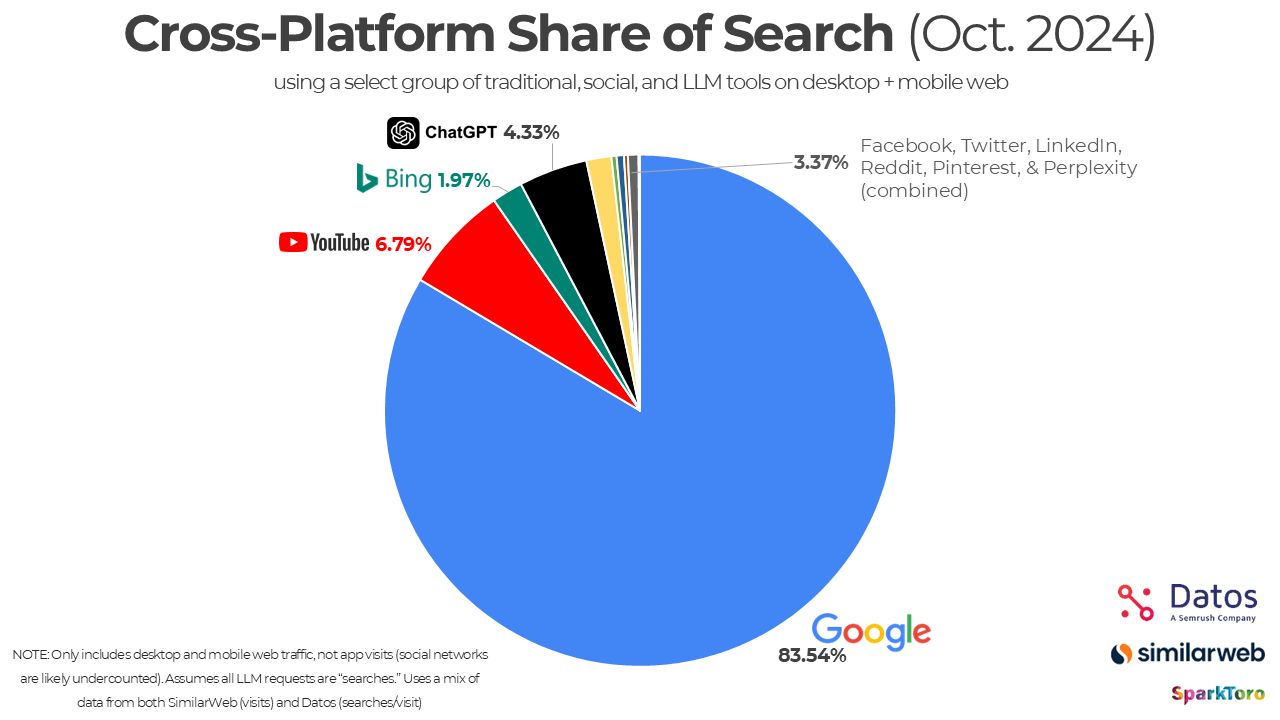
You might be thinking: “All of this is interesting, but how big is the phenomenon really? My clients are still using Google…” It’s true: for now, searches through generative engines still represent only a small share of total web searches. For example, a Similarweb study shared by Rand Fishkin estimated that ChatGPT (in Search mode) accounted for just 4.33% of queries compared to traditional search engines.
In other words, the majority of traffic is still on Google and the like at this point. But beware: although this share is modest, it is growing rapidly — and more importantly, the underlying trend is changing the way users find information.
Here’s why GEO deserves your attention right now:
- The rise of conversational and voice search: AI assistants (from Siri to Alexa, and even chatbots in our browsers) are becoming increasingly capable of responding in natural language or even out loud. Younger generations sometimes prefer asking a bot directly rather than typing a traditional query. Generative engines provide more natural, contextual answers than the old assistants, which could further democratize voice search through smartphones and connected devices. If voice search takes off thanks to AI, you’ll want your business to be part of the spoken answers these tools deliver.
- Younger users adopt new interfaces faster: there’s a generational difference in adoption. Younger internet users readily embrace tools like ChatGPT for their searches, while older generations remain more faithful to Google. If your target audience includes digital natives, it’s strategic not to miss the GEO opportunity. Being absent from AI responses could mean missing part of your future audience.
- The convenience of direct answers: “Zero-click search” at its peak: let’s admit it — we all love getting an immediate answer to a simple question without digging through 10 websites. Generative engines excel here: for many basic or informational queries, they provide the answer directly, saving users from hopping across multiple pages. This fulfills a need that traditional SERPs only partially addressed. The consequence for businesses: more and more queries (especially informational ones, “top 10” lists, tutorials, etc.) may no longer generate clicks to websites, since the AI summarizes everything itself. Early signs already point to a decline in clicks on certain “top of funnel” content (general blog posts, lists, how-to articles) as AI answers replace them. Failing to adapt your strategy could mean losing visibility and organic traffic on those queries — to competitors the AI decides to highlight.
- More qualified leads thanks to AI: while the volume of traffic from AI-generated answers is still smaller today, the quality of interactions and conversions can be higher. Experts note that users treat AI almost like a trusted advisor, which increases the conversion rate of AI-generated recommendations. In other words, if ChatGPT “recommends” your product or site, the user who clicks is already positively inclined — almost as if a friend suggested it. This can result in a stronger conversion rate (even if the total number of leads remains lower than through Google). That’s a promising sign: fewer clicks, but more qualified ones with higher potential to turn into customers.
- An opportunity to get ahead of the competition: GEO is still new, and few businesses are actively optimizing for it. That means now is the time to be a pioneer. Showing up in AI answers before your competitors do allows you to gain valuable share of voice. As generative search grows in market share, you’ll already have a head start. Conversely, ignoring GEO now means risking playing catch-up later. Just look at how quickly giants like Apple are announcing the integration of AI engines (Perplexity, Claude) into products like Safari. The shift can accelerate overnight.
In short, GEO will take on an increasingly important role in online visibility strategies. While Google and traditional SEO remain indispensable today, it is wiser to start considering GEO right now as an essential strategic complement. As one expert summed it up: “GEO isn’t going anywhere, so keeping up and earning visibility in GEO makes sense. Just remember to manage GEO with SEO.”
In other words, don’t put all your eggs in the AI basket — but add this new lever to your marketing arsenal to ensure your visibility no matter what.
Challenges for lead generation and business visibility
From a company’s perspective, what does the rise of generative search actually change for lead generation and visibility? Here are the main challenges to keep in mind:
1. The potential decline of “traditional” organic traffic: as mentioned, if AI provides a complete answer, users click less on results. Fewer clicks to your site means fewer opportunities to capture leads via your forms, newsletters, etc. For example, a website relying on “How to do X” tutorials could see its traffic drop if users get the step-by-step directly from a chatbot. It therefore becomes crucial to anticipate this decline by investing in the channels where users now find their answers (AI platforms) to capture that contact in a different way.
2. The importance of being in the answer (otherwise, you don’t exist): on Google, you could still hope for traffic being the #3 or #4 result, or even on page 2 for niche queries. With a generative engine, either your brand is cited in the answer, or it’s invisible. It’s almost all or nothing. A concrete example: imagine a user asks ChatGPT, “What is the best project management software for a small business?” The AI will likely list 2 or 3 recommended tools, each with a short explanation. If your software is on that list, you reach the prospect; if not, the prospect won’t even know you exist. There’s no page 2 where they might discover you. For lead generation, being included in the AI’s answer is therefore critical, especially for “product discovery” queries.
3. A shorter user journey: AI can act as a filter by presenting only a few options instead of dozens of results. This means the discovery journey is shorter and concentrated on the first suggestions. If your offer is among them, the potential lead arrives already further along in their decision-making (the AI has done the initial comparison work for them). They are warmer, more convinced. But if you are absent from the AI answer, they won’t come at all. GEO thus impacts the conversion funnel: it shortens the information-gathering phase and can deliver more qualified prospects directly at the consideration/purchase stage.
4. Rethinking conversion content: less traffic doesn’t necessarily mean fewer conversions if the remaining traffic is of higher quality. You’ll likely need to optimize your landing pages and conversion content (product demos, free trials, etc.) to welcome these AI-driven visitors. They often arrive through a direct link in the answer (e.g., “Learn more on [your brand]’s website”). They come looking for more detail or proof after the AI’s recommendation. Your site must therefore be flawless to quickly convince them: clear content, social proof, visible calls-to-action. GEO may bring you fewer visitors, but you need to convert them better.
5. Measuring and monitoring your presence in AI: as noted, new metrics and tools come into play. You’ll need to monitor whether and how your brand is mentioned by AIs. Some companies are already conducting qualitative monitoring: regularly asking sample questions to ChatGPT, Bing Chat, Perplexity, etc., to see if their content or products are cited. Specialized tools are emerging (e.g., AI search graders) to make this easier. This monitoring is critical: it helps you understand how AI portrays your company (accuracy of information, positive/negative sentiment, etc.) and adjust your content strategy accordingly. It’s somewhat the equivalent of SEO ranking tracking, but transposed into AI-generated answers.
In summary, GEO presents a dual challenge for businesses: not losing the visibility already gained through traditional SEO, by continuing to feed that channel, while also building visibility on the new generative channels. Those who succeed in this transition can turn the threat – less “easy” organic traffic – into an opportunity : more qualified leads, and a competitive edge in a still underexploited space.
For more general insights on integrating AI into your business, check out this article.

